Energy & transmission
Production, storage, and redundancy for night operations and emergencies.
Module 02: Build
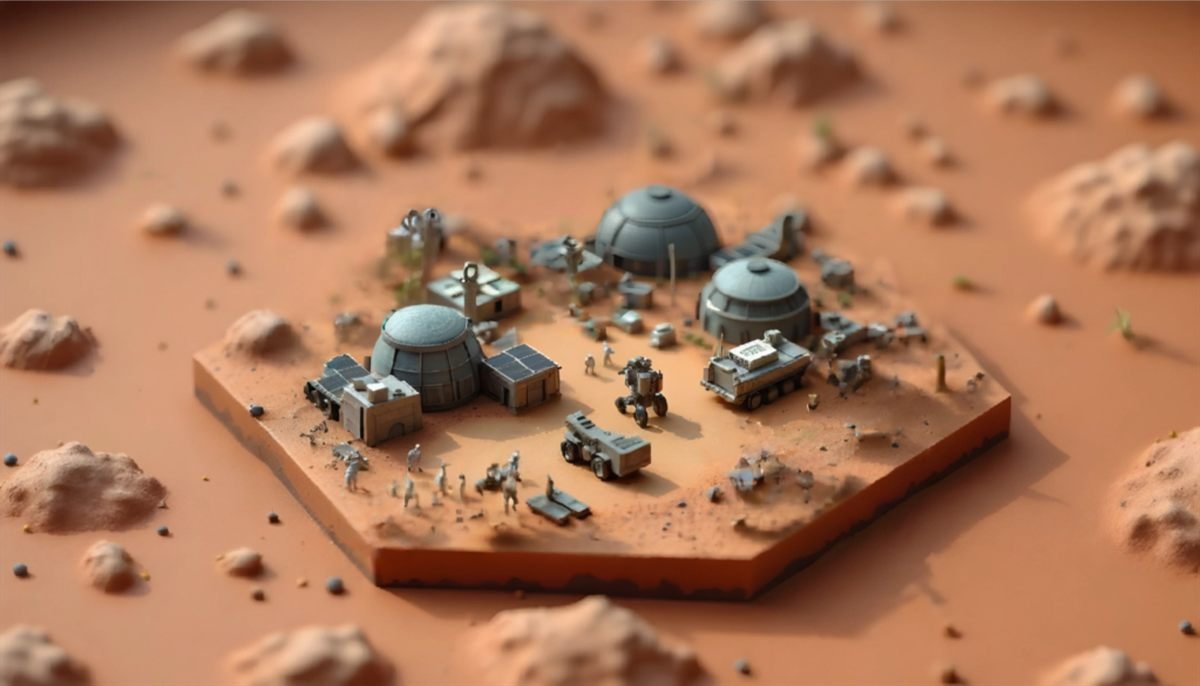
Your proposal is only half the brief. Every team also builds a physical model of its colony on a one-metre hexagonal board, the same board every other team builds on, because on showcase day they all connect into a single continuous Mars diorama.
Specialisations
Divide these between your teams. Each one serves a specific function in keeping the colony alive, and each must connect seamlessly with the rest of the Mars base.
Production, storage, and redundancy for night operations and emergencies.
High-tech farming and livestock to feed 650 people, every single day.
Residential, recreational, and entertainment facilities worth living in.
Extracting and processing water, gases, and minerals from the planet itself.
Launch, landing, refuelling, maintenance, and cargo handling.
Laboratories, rovers, and reconnaissance vehicles for the surface.
Forward bases that make future colony expansion possible.
Turning raw Martian material into usable components on site.
Holding and moving resources and cargo across the whole colony.
The first hardware your crews live in while they build everything else.
Materials
Every team receives the same starting materials. It is up to you to model a Mars base that matches the proposal you pitched.
Conceptualise the model by sketching and designing to begin. If possible, convert your designs to 3D models using modelling software. Afterwards, you can 3D print or use up-cycled materials in order to build a realistic model of your colony. We encourage the use of electronics such as Arduino and Raspberry Pi to enhance your finished product presentation.
Electronics are capped at 12V DC. Direct 240V AC electrification of a model is strictly prohibited. Nothing may extend beyond your board's footprint in a way that blocks a neighbouring team from connecting to it.
Cutting, soldering, and hot tools are used only in supervised build areas with the correct protection. Batteries are stored and charged under adult supervision. Clean your workspace and account for every tool at the end of each session.
On Mars nothing is thrown away, and the judges look for the same discipline in your model. Reuse offcuts, upcycle packaging, and be able to explain where every resource in your colony comes from, where it goes and when it is spent.
Full submission formats, power limits, and penalties live in the official rules.